
How to Teach Children CPR Safely and Clearly
- Coachaj Lifesaver
- Aug 24
- 6 min read

A child who knows what to do when an adult collapses may be able to summon help, find an AED, or begin life-saving actions before emergency services arrive. That is why learning how to teach children CPR is not about creating young paramedics. It is about giving them a calm, memorable response to a frightening emergency.
For parents, schools and community leaders, the most effective approach is practical, supervised and suited to the child’s age. Children should leave a session knowing that their first duty is to get help, their second is to stay safe, and that trying to help is always better than standing by in silence.
What children need to understand first
CPR is only one part of the emergency response. Before teaching hand placement or compression rhythm, explain the situation in plain language: if someone is unresponsive and not breathing normally, it is an emergency. A person may make occasional gasping sounds, but this is not normal breathing.
Children should be taught to check for danger before approaching. Traffic, water, electricity, fire, violence and unsafe surroundings can turn one casualty into two. If the area is not safe, their role is to move away and call for an adult or emergency services.
The next message is simple and repeatable: check, call, help. Encourage children to speak loudly to the person, ask whether they are okay, and look for a response. If there is no response, they should call for a nearby adult immediately. Older children should also know how to call the local emergency number. In the UAE, ambulance services can be contacted on 998. They should be ready to say where they are, what has happened, and whether the person is awake and breathing.
This foundation matters because a child may not have the strength, reach or confidence to provide sustained CPR. They can still make the decisive difference by alerting others quickly and accurately.
How to teach children CPR through practice
A calm demonstration is more effective than a long lecture. Use a CPR manikin whenever possible, explain each action as you show it, then let children repeat the sequence under supervision. Keep the language consistent across every practice round so that it becomes easier to recall under pressure.
Start with the emergency response, not compressions. Ask the group what they would do if they found someone lying on the ground. Guide them through checking that the scene is safe, trying to get a response, shouting for help, and making an emergency call. If a child is too young to use a mobile phone independently, they should know to find a responsible adult without delay.
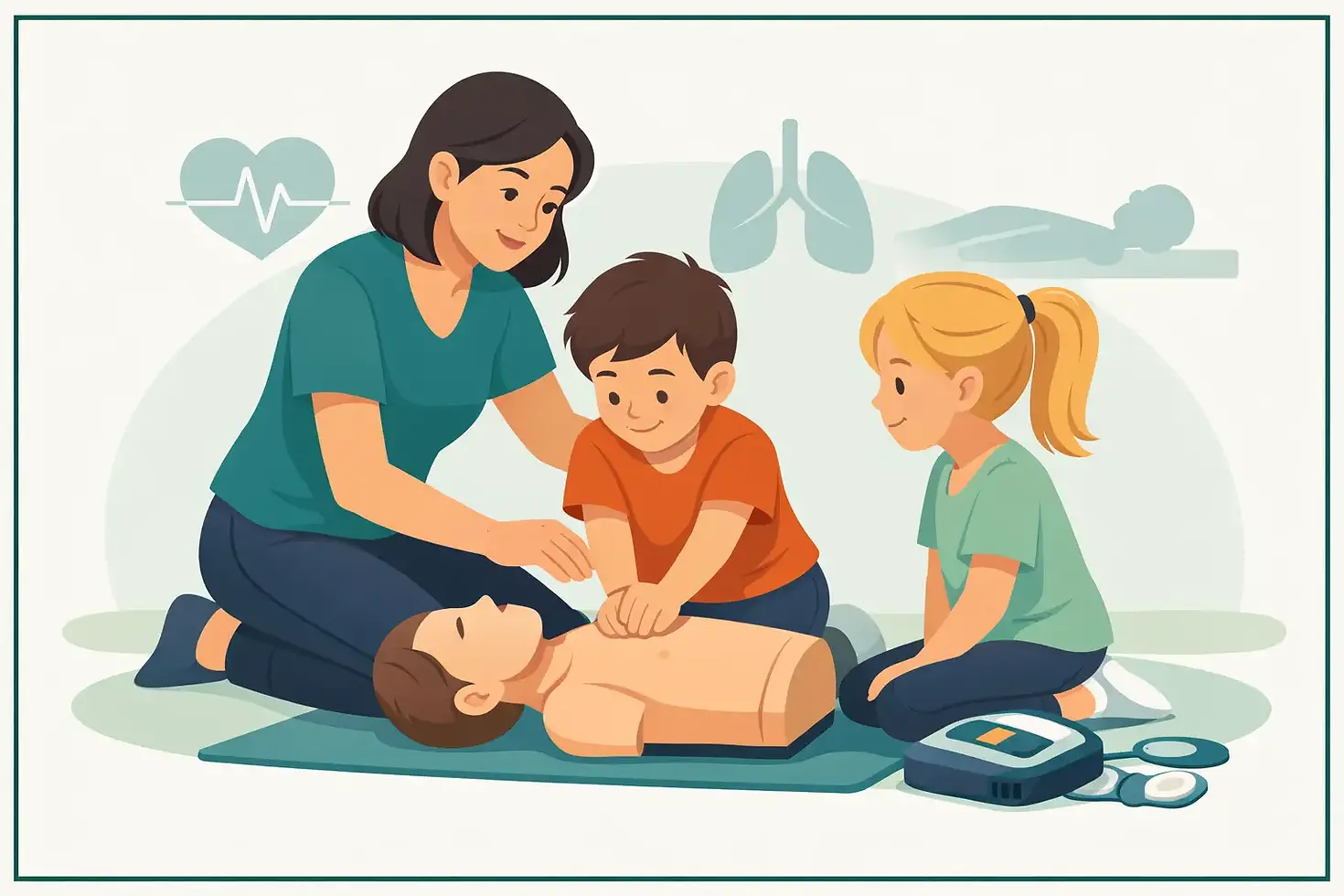
Once help has been called, show older children how chest compressions work on a manikin. Explain that the centre of the chest is the target area and that compressions need to be firm, fast and continuous. A steady rhythm of around 100 to 120 compressions a minute is the standard taught in CPR courses. Counting aloud or using a familiar song with an appropriate beat can help children keep pace during training.
Avoid asking children to practise compressions on one another. Even playful practice can cause discomfort or injury, and it can blur the line between a real emergency and a game. Manikins, cushions used only for positioning practice, and instructor demonstrations are safer choices.
Rescue breaths require additional skill, infection-control awareness and confidence. Whether they are included in a child’s training depends on age, the setting and the level of instruction available. For many younger children, it is appropriate to focus on calling for help and hands-only chest compressions. Older children can be taught rescue breaths by a qualified instructor using suitable manikins and clear hygiene procedures. Emergency call handlers can also give immediate instructions during a real incident.
Use short scenarios rather than abstract questions
Children learn best when they can picture a situation. Instead of asking them to memorise a list of instructions, create brief scenarios: a grandparent becomes unresponsive at home, a coach collapses at a sports session, or someone falls in a shopping centre.
Ask what they would do first, who they could ask for help, and what information emergency services would need. Let them take turns being the caller, the helper and the observer. The observer can identify good actions, such as checking for danger or sending someone to find an AED. This makes training active without making it frightening.
Use realistic but measured language. There is no need to show distressing images or describe worst-case outcomes. The aim is confidence and readiness, not anxiety. Children should understand that an adult may look after them after an emergency too, because helping in a serious incident can be upsetting.
Introduce AEDs as a tool, not a mystery
An automated external defibrillator, or AED, can be used by members of the public and gives spoken instructions. Children do not need to understand the electrical science behind it. They do need to know that an AED is designed to guide the user, that it should be brought to the casualty as quickly as possible, and that nobody must touch the person when the device says to stand clear.
Where an AED training unit is available, show children how to switch it on and follow its voice prompts. Emphasise that they must not use a real AED for practice. In a real emergency, an older child may be able to collect the device, bring it to an adult helper or follow the instructions with support.
Adapt CPR teaching to the child’s age
There is no single lesson plan for every child. Attention span, physical strength, language ability and emotional maturity all affect what a learner can take in. A six-year-old may reliably learn to recognise an emergency, fetch help and call 998 with an adult nearby. A teenager may be ready to practise a full response sequence on a manikin, use an AED trainer and take responsibility for directing bystanders.
For younger children, use three or four short messages and repeat them often. Phrases such as “get help fast”, “call 998”, and “push in the middle of the chest if you have been shown how” are easier to retain than technical terminology.
For older children, explain the reason behind the actions. Chest compressions circulate blood when the heart has stopped working effectively. Fast emergency calls bring professional care sooner. An AED can analyse the heart rhythm and advise whether a shock is needed. Understanding the purpose of each step improves judgement without overloading the learner.
Children with additional learning needs may benefit from visual cards, role-play, repetition and a quieter teaching environment. Adaptation is not a reduction in standards. It is how training becomes usable for the person receiving it.
Set clear boundaries for safe learning
Children must know that CPR is for a person who is unresponsive and not breathing normally. They should never practise it on a friend, sibling or pet. They should never delay calling for help while looking for the perfect answer, and they should not put themselves in danger to reach a casualty.
It is also helpful to address a common fear directly: children do not need permission to call emergency services when they believe someone may be seriously ill or injured. A call handler will ask questions and guide the caller. If an adult is present, the child should alert that adult, but they should not wait if nobody responds.
Schools and youth organisations should make this message part of a wider safeguarding and emergency plan. Staff need to know where AEDs are located, who leads the response, how emergency access is managed, and how pupils will be cared for after an incident. CPR awareness is stronger when it sits within a rehearsed system rather than a one-off assembly.
Make CPR education a regular part of preparedness
A single lesson can create awareness, but skills fade without practice. Brief refreshers each term or year are more valuable than an intensive session that is never revisited. A five-minute scenario during a school safety day, a reminder of the emergency number, or a supervised manikin practice can reinforce the essential sequence.
For organisations serving families, schools or community groups, consistent delivery matters. The terminology, practical standard and emergency guidance should align with recognised first aid practice and local procedures. Accredited instructors can tailor sessions for different age groups while ensuring that children receive accurate, responsible advice.
Lifesaver Abu Dhabi delivers practical paediatric and community first aid training that can help schools, parents and organisations build this capability with confidence. The strongest programmes combine age-appropriate teaching with realistic equipment, instructor oversight and a clear plan for what happens after the lesson ends.
A child does not need to perform every element of adult CPR perfectly to be a life-saver. If they can recognise an emergency, call for help, bring an AED and start safe, taught actions, they have already moved from helplessness to purposeful care.


Comments