
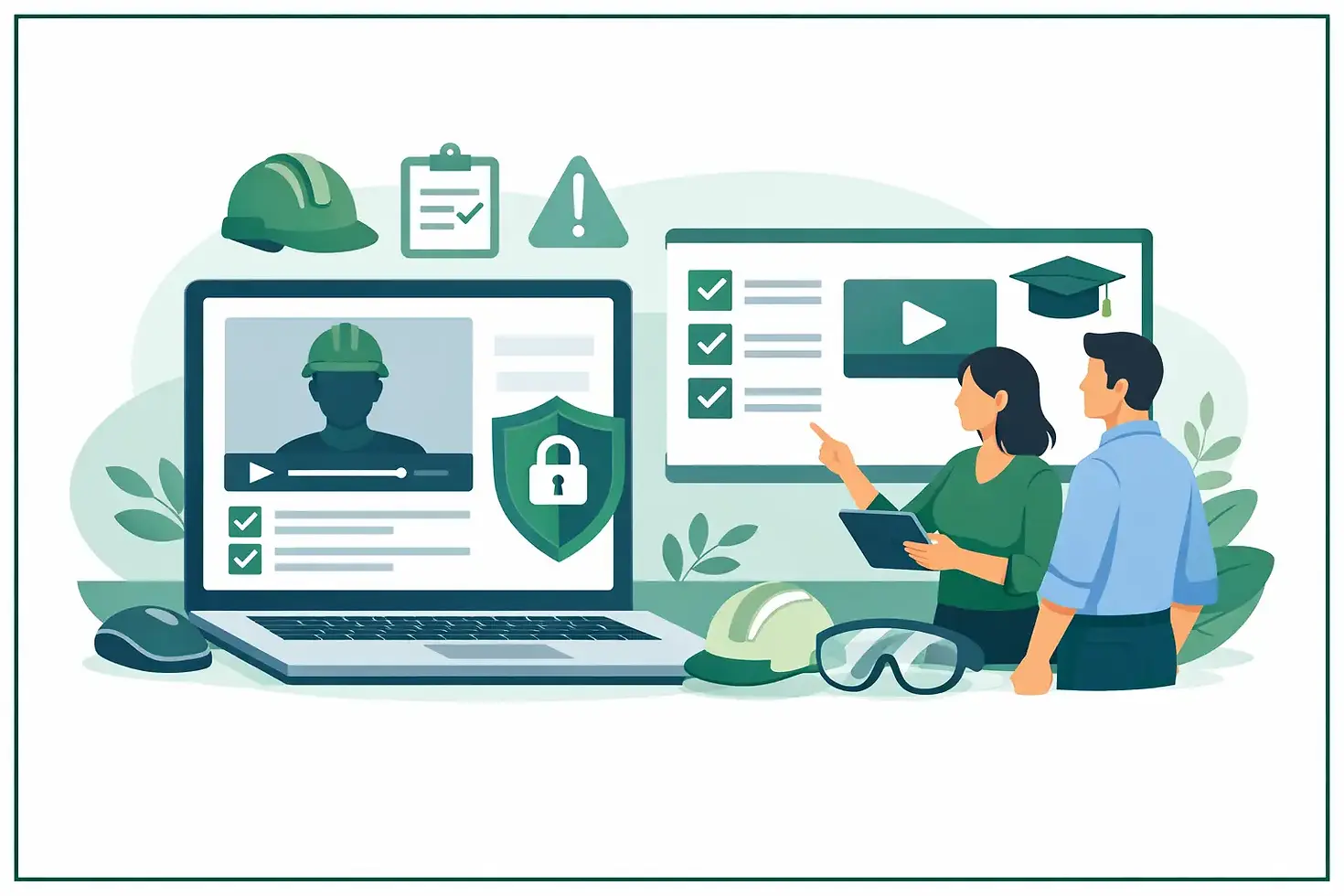
Choosing Online Safety Training Courses
- Coachaj Lifesaver
- Jun 7
- 6 min read

A safety manager rarely has the luxury of training in perfect conditions. Teams are split across sites, shifts are tight, contractors join at short notice, and compliance deadlines do not move. That is why online safety training courses have become a practical part of modern workforce readiness. Used well, they help organisations train at scale, document competence, and keep essential knowledge current without pulling entire teams off the job at once.
The key phrase there is used well. Not every subject belongs fully online, and not every e-learning package is fit for a regulated or high-risk environment. For employers, schools, field operators and family learners, the real question is not whether digital training is convenient. It is whether it is credible, relevant and capable of improving behaviour when it matters.
What online safety training courses do well
The strongest online programmes solve a real operational problem. They make consistent training available across different locations, standardise core messages, and give learners access when classroom attendance would otherwise delay completion. For large employers, that can mean faster onboarding and cleaner training records. For smaller organisations, it can mean access to accredited learning without the cost of assembling a full classroom every time a new starter arrives.
There is also a quality advantage when content is well designed. A good online module can present legislation, hazard awareness, reporting duties and emergency procedures in a structured way that learners can revisit. That matters because safety information is often forgotten when delivered once and never refreshed.
For sectors with rotating personnel, mobile teams or geographically dispersed operations, online delivery can support continuity. It helps maintain a baseline standard, especially for awareness-level topics such as fire safety, manual handling theory, display screen equipment, safeguarding awareness, infection prevention or workplace health and safety induction.
Where online safety training courses have limits
Convenience is not competence on its own. Some training outcomes require observation, coaching and practical assessment. If a learner must physically demonstrate a technique, use equipment correctly, lead an evacuation, administer first aid or respond under pressure, online learning alone is unlikely to be enough.
This is where many organisations make avoidable mistakes. They buy a broad catalogue, assign courses to everyone, and treat completion certificates as proof of readiness. In reality, the right model depends on the risk profile. Awareness can often be taught online. Performance usually needs blended delivery, scenario work or face-to-face assessment.
That distinction matters in first aid, hostile environment preparation, lifeguarding, emergency response and any setting where hesitation or poor technique carries serious consequences. Digital learning can prepare people with theory, language and decision frameworks. It should not replace supervised practice where practical capability is required.
How to assess course quality before you buy
A course may look polished and still be unsuitable. Buyers should start by checking whether the content maps to a recognised standard, regulatory requirement or sector expectation. Accreditation is useful, but it should be relevant rather than decorative. A certificate has value when it is recognised by employers, procurement teams, auditors or governing bodies who may later review your training records.
Next, look at the learning design. Strong courses do more than display slides and ask simple multiple-choice questions. They explain why procedures exist, show real workplace examples, and test judgement rather than memory alone. If the content never moves beyond obvious statements, learners will complete it quickly and retain very little.
Reporting is another practical issue that often gets ignored until audit season. Organisations need clear records of enrolment, completion, expiry dates and, in some cases, assessment outcomes. If the platform makes documentation difficult, the administrative burden returns to your team.
It is also worth asking whether the provider understands your operating environment. A generic package may be acceptable for low-risk awareness topics, but organisations in education, security, healthcare, industrial operations or field deployment usually need training aligned to real conditions. Local context, workforce language needs and role-specific risks all shape whether learning translates into safer behaviour.
When online delivery is the right choice
Online training is often the right first step for compliance-heavy subjects that require consistent knowledge transfer across a broad audience. This includes induction topics, refresher learning, annual awareness modules and policy-linked training that must be completed by large numbers of employees.
It is especially effective where the training objective is to help staff recognise hazards, follow reporting lines, understand responsibilities and respond appropriately in the early stages of an incident. In those cases, digital delivery can improve access and completion rates without weakening the message.
It can also work well before classroom sessions. Learners arrive with the same foundation, instructors spend less time covering basic theory, and practical sessions can focus on application. For busy organisations, that blend can reduce downtime while improving the standard of face-to-face training.
When you need more than e-learning
If your duty of care extends into high-risk operations, online training should be part of a broader system rather than a standalone answer. The more severe the consequences of failure, the more important it becomes to validate performance in realistic conditions.
Take first aid as an example. Understanding the chain of survival, consent, casualty assessment and incident reporting can be introduced online. But CPR quality, recovery position technique, bleeding control and scene management need hands-on practice. The same principle applies to evacuation leadership, water safety response, hostile environment procedures and instructor development.
For this reason, many mature organisations now separate learning into three layers: knowledge, rehearsal and verification. Online modules deliver the knowledge. Practical sessions create rehearsal. Assessment and records provide verification. That structure is stronger than relying on any single format.
Choosing courses for different audiences
A school, an oil and gas contractor, a local business and a parent at home do not need the same training package. The best online safety training courses are selected by role, exposure and consequence, not by what happens to be available in a catalogue.
For office-based teams, core workplace subjects may be enough, provided the material is current and easy to complete. For schools, safeguarding, emergency awareness and paediatric safety topics may deserve greater weight. For field teams, remote travel, incident escalation, communications discipline and environmental risk may be more relevant than generic office compliance modules.
This is also why customisation matters. Training should reflect the equipment people use, the incidents they are most likely to face and the reporting expectations inside the organisation. A standard module can establish a baseline, but customised content usually produces stronger engagement because learners recognise their own environment in the material.
Providers such as Lifesaver Abu Dhabi are often chosen for this reason. Buyers are not only looking for a course library. They are looking for a training partner that can align accredited learning with operational reality, compliance needs and, where necessary, practical delivery on the ground.
What procurement and HSE teams should ask providers
Before committing to a provider, ask direct questions. Is the training accredited, and by whom? How often is content reviewed? Can reporting be exported easily for audit purposes? Are courses suitable for your jurisdiction and sector? Can online modules be combined with practical training if your risk profile demands it?
Also ask about learner support and completion rates. A course that is technically available but poorly structured can create drop-off, frustration and repeated chasing by managers. The smoother answer is not always the cheapest option. In many cases, the better value lies in content that people actually finish, understand and apply.
Finally, check what happens after completion. Does the provider support refresher planning, blended pathways and broader safety consultation? Organisations with complex operations usually benefit from continuity rather than piecemeal purchasing.
The decision is not online or classroom
Too many training discussions are framed as a choice between digital learning and in-person instruction. In practice, the strongest safety programmes use both. They match the delivery method to the outcome, the audience and the risk.
Online learning brings scale, consistency and speed. Classroom and practical sessions bring observation, correction and confidence under pressure. If you need awareness, online may be sufficient. If you need performance, online should prepare the ground, not carry the full load.
That is the standard worth holding. Safety training should not only satisfy a checklist. It should help people recognise danger earlier, act more decisively and protect others with confidence. When online courses are selected with that standard in mind, they become more than a convenience. They become part of a safer organisation.


Comments