
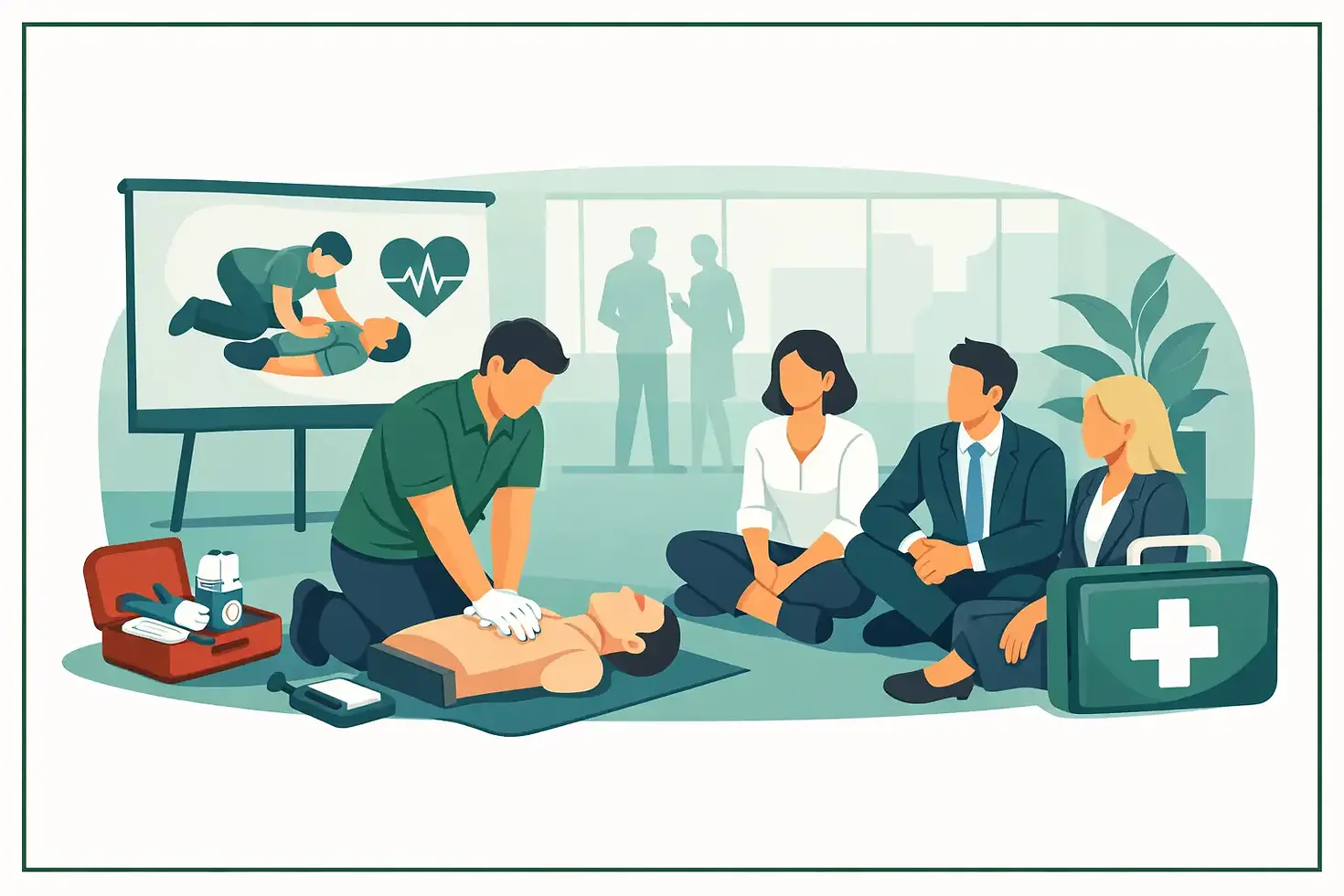
Corporate First Aid Training That Works
- Coachaj Lifesaver
- May 31
- 6 min read

When an employee collapses in an office, a contractor suffers a deep cut on site, or a visitor shows signs of cardiac arrest, there is no time for uncertainty. Corporate first aid training exists for that exact moment - when a fast, correct response can protect life, reduce harm, and steady a workplace under pressure.
For many organisations, first aid is still treated as a compliance box to tick. That approach leaves a gap between certification and actual readiness. A certificate on file may satisfy an audit, but it does not always mean staff can assess a casualty, manage a choking incident, use an AED, or coordinate calmly until emergency services take over. Good training closes that gap. It gives businesses practical capability, not just paperwork.
Why corporate first aid training matters beyond compliance
There is a legal and moral duty of care in every workplace, but the operational case is just as strong. A trained team can reduce the severity of an incident in its first minutes. Those early actions matter. They can preserve an airway, control bleeding, position a casualty safely, and prevent a manageable emergency from becoming a critical one.
That matters in offices, schools, warehouses, industrial sites, hospitality venues, transport operations, and remote field settings. The risk profile changes, but the principle does not. People need to know what to do, who should act, and how to work within a clear emergency response process.
It also matters for business continuity. Incidents create disruption, stress, reputational exposure, and sometimes long investigations. Organisations that take training seriously are usually stronger in adjacent areas as well - reporting, evacuation, supervisor accountability, and wider health and safety culture. First aid is not an isolated function. It is part of operational readiness.
What effective corporate first aid training should include
The best courses balance recognised standards with the realities of the workplace. That means teaching core first aid principles while tailoring scenarios, hazards, and response procedures to the organisation itself.
At a minimum, training should cover casualty assessment, CPR, AED use, choking, bleeding control, burns, fractures, shock, unconscious casualties, and how to escalate correctly. Yet a generic classroom session is not always enough. A corporate environment may need instruction shaped around site access, lone working, machinery hazards, heat exposure, security concerns, or delayed medical support.
This is where quality matters. Effective programmes use realistic exercises, competent instructors, and enough practical repetition for people to remember what they have learned under pressure. Staff should leave knowing not only the treatment steps, but also their limits. Good first aiders do not improvise beyond their competence. They assess, intervene safely, and hand over clearly.
Corporate first aid training in different workplace settings
One of the biggest mistakes organisations make is assuming one course fits every team. It rarely does.
In a low-risk office, the priority may be medical emergencies, slips and falls, fainting, or cardiac incidents involving staff and visitors. In a warehouse or industrial environment, bleeding, crush injuries, fractures, and trauma may be more relevant. In schools and childcare settings, the profile changes again, with higher emphasis on allergic reactions, choking, asthma, and child-specific protocols.
For companies with drivers, field teams, security personnel, or remote workers, the training requirement is often broader. Staff may need to manage an incident for longer before outside help arrives. In those environments, scenario-based learning becomes especially valuable because the pressure, isolation, and consequences are different.
The right provider will ask questions before the course begins. How many people are on site? What are the main hazards? Are there shift patterns? Is there public access? Are there language considerations? Are there client or regulatory requirements? These details shape the difference between a standard course and a useful one.
Choosing a provider for corporate first aid training
Not all training providers deliver the same outcome. Some offer low-cost certification with limited practical depth. Others operate as safety partners, helping organisations align training with risk, policy, and real-world response.
For most employers, accreditation is the starting point, not the finish line. You need recognised certification, but you also need instructors with operational credibility, clear quality control, and the ability to adapt delivery to your sector. That is particularly important for government entities, high-risk operators, schools, and businesses with large or distributed workforces.
It is also worth looking at delivery capability. Can the provider train on your premises? Can they handle large groups without diluting quality? Can they schedule around operations? Can they support refresher planning, requalification, and blended learning where appropriate? These practical points affect uptake and consistency far more than many businesses expect.
A serious provider should also be comfortable discussing confidentiality, incident sensitivity, and organisational risk. In many sectors, safety training is not a generic HR purchase. It sits within a wider compliance and readiness framework.
Certification matters, but retention matters more
A common problem with first aid training is skill fade. Staff complete a course, pass assessment, and then go months or years without practising. When an emergency happens, confidence drops and hesitation appears.
That does not mean certification has limited value. It means organisations should treat training as part of an ongoing safety system. Short refreshers, practical drills, AED familiarisation, and site-specific exercises help maintain readiness. Even brief scenario sessions during the year can improve recall significantly.
This is especially important in larger businesses where appointed first aiders may change roles, move departments, or leave the organisation. Without regular review, coverage can quietly weaken. The business assumes it is protected because training happened once, while the actual response capability on the ground has diminished.
The business case for tailored training
Tailored corporate first aid training usually costs more than the most basic off-the-shelf option. For some organisations, that creates hesitation. Yet the cheaper route often brings weaker engagement and less relevance.
If staff spend a day learning scenarios that do not resemble their workplace, retention is lower. If training is too generic, confidence in a real incident may still be poor. Tailored delivery tends to improve participation because staff can see exactly how the learning applies to their own environment.
There is, however, a balance to strike. Not every business needs an advanced or highly specialised programme. A straightforward office with limited risk may be well served by a standard accredited course with a small amount of site-specific adaptation. A construction contractor, energy operator, school group, or security team may need much more. The right level depends on hazard, workforce profile, and operational exposure.
Building a stronger duty of care culture
The best organisations do not present first aid training as an isolated legal requirement. They position it as part of how they protect people. That message matters. When staff understand that training is there to support colleagues, contractors, customers, pupils, or the public, engagement improves.
It also helps to connect first aid with the wider emergency plan. Where is the equipment kept? Who calls emergency services? Who meets responders at the entrance? How is an incident recorded? What happens after handover? Training is stronger when these answers are clear and practised.
For businesses operating in Abu Dhabi and across demanding sectors, that standard of readiness is not excessive. It is sensible. Providers such as Lifesaver Abu Dhabi are often chosen for exactly this reason - not simply to deliver a course, but to support organisations with accredited, practical training that fits operational reality.
When should a company refresh its approach?
Usually sooner than it thinks. If your current provision was selected only on price, if no one has reviewed the first aider roster in the past year, or if training is disconnected from the actual risks on site, it is time to reassess.
The same applies after organisational change. New premises, new equipment, higher headcount, longer operating hours, more public footfall, or expansion into remote work all affect first aid requirements. So do lessons from near misses and past incidents. A sensible training strategy evolves with the business.
Corporate first aid training is at its best when it creates calm capability. Not theatre, not jargon, and not a file of expired certificates in a drawer. Just trained people who can step forward, make safe decisions, and protect life when the moment demands it. That is a standard worth building before you need it.


Comments