

Medical Evacuation Planning That Saves Time
- Coachaj Lifesaver
- Aug 12
- 5 min read

When a serious injury or illness occurs at a remote site, during a field operation or in a high-risk workplace, the first question is rarely whether help is needed. The real question is whether the organisation can arrange a medical evacuation quickly, safely and with the right clinical information already in hand. Minutes matter, but so do decisions made well before the incident.
For employers, government teams, schools, humanitarian organisations and operators working beyond immediate hospital access, evacuation capability is part of duty of care. It is not simply a transport arrangement. It is a coordinated response that connects first aid, clinical assessment, communications, transport, receiving facilities and accountable leadership.
What medical evacuation means in practice
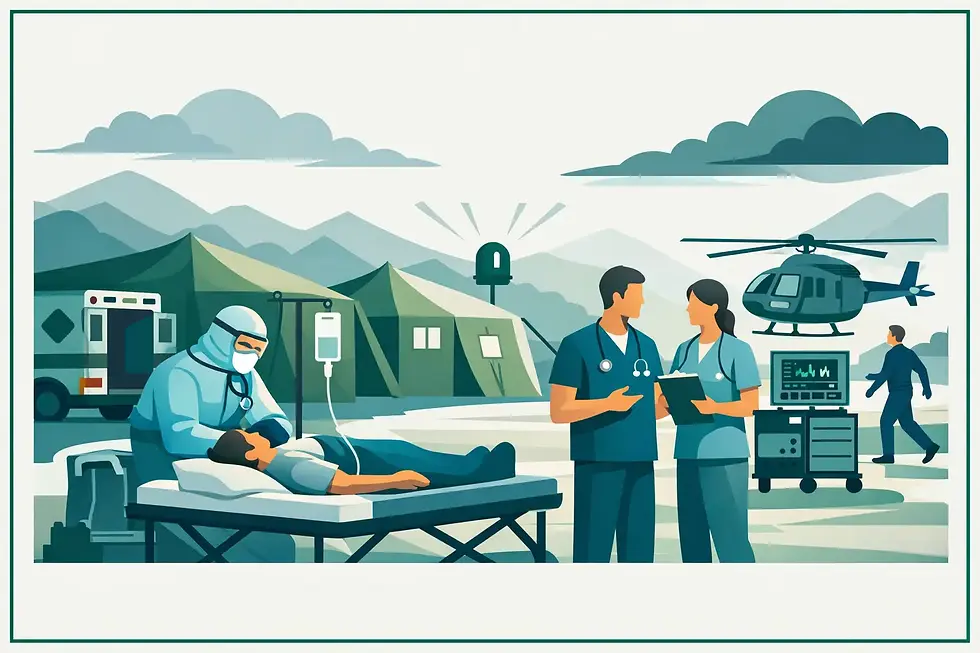
Medical evacuation, often shortened to medevac, is the organised movement of a patient from the point of illness or injury to an appropriate level of medical care. That may involve a road ambulance from a worksite to a local hospital, an air ambulance from an offshore or desert location, or transfer between facilities when specialist treatment is required.
The right method depends on the patient’s condition, the location, weather, distance, security context and available clinical resources. An air transfer may appear to be the fastest option, but it is not automatically the safest or most appropriate. If a well-equipped hospital is accessible by road and the patient can be safely stabilised, ground transport may offer the better outcome.
Medical evacuation should also not be confused with routine repatriation. Repatriation commonly concerns returning a patient to their home country or preferred healthcare system after treatment. Medevac is driven by immediate clinical need and the requirement to reach suitable care without avoidable delay.
The decision starts before transport
A sound evacuation decision begins with assessment at the scene. Trained first aiders, medics or emergency responders must identify immediate threats to life, provide care within their competence and activate emergency support. Their role is not to diagnose beyond their training, but to recognise when escalation is necessary and communicate clear, useful information.
In a workplace setting, the incident lead also needs a reliable escalation route. Who contacts the emergency services? Who informs site management? Who meets the ambulance at the gate? Who provides the patient’s medical information, medication details and next-of-kin contact if available? Confusion at this stage can create harmful delays even when vehicles and clinicians are available.
For serious cases, decisions should be guided by clinical advice wherever possible. A remote doctor, medical control centre or appointed healthcare provider can help determine the required level of transport, including whether the patient needs monitoring, oxygen, advanced life support capability or an accompanying clinician.
A medical evacuation plan needs more than a contact number
Posting emergency telephone numbers is necessary, but it is not an evacuation plan. A workable plan accounts for the conditions people will face when an emergency occurs: poor signal, restricted access, extreme heat, shift changes, remote camps, site security and language barriers.
At minimum, an organisation should establish the following operational elements:
Clear criteria for escalating from onsite first aid to emergency medical services or specialist evacuation.
Accurate site coordinates, access instructions, entry permits and a nominated rendezvous point for responders.
Defined responsibilities for first aiders, supervisors, security staff, transport coordinators and senior decision-makers.
Current information on nearby medical facilities and the level of care each can provide.
Communication methods that still function if a primary mobile network, radio channel or site system fails.
A process for recording the incident, protecting confidentiality and reviewing lessons after the event.
These arrangements must reflect the actual environment. A corporate office in Abu Dhabi may require straightforward ambulance access, trained first aid personnel and clear building entry procedures. A project in a remote industrial area, a marine operation or a hostile environment requires deeper planning, including extraction routes, communications redundancy, security coordination and potential casualty holding arrangements.
The handover is a clinical safety measure
Transport is only one part of the response. The quality of the clinical handover can influence what happens next.
A receiving team needs a concise account of what happened, when it happened, the patient’s condition, observations where available, first aid or treatment provided, allergies, known medical history and any medication taken. A structured handover reduces the risk that critical details are lost between the scene, ambulance crew and hospital staff.
Organisations should train teams to document facts rather than assumptions. For example, record the time a casualty was found, the mechanism of injury, whether consciousness changed and when emergency services were called. Avoid speculation about cause or prognosis. Accurate records support clinical continuity, internal investigation and legal defensibility.
Confidentiality matters throughout. Medical details should be shared only with those who need them to arrange care, support the patient or fulfil legitimate organisational responsibilities. A serious incident can attract attention from colleagues and family members, but privacy remains part of respectful care.
Training creates capability under pressure
An evacuation plan on paper is not proof of readiness. People need practical training that reflects their roles. First aiders require confidence in immediate care and escalation. Supervisors need to understand command, communications and scene control. Security and reception teams need to know how to direct responders without creating access delays.
Scenario-based exercises are particularly valuable because they reveal the gaps no document can show. Can the ambulance reach the site entrance? Does the night team know the assembly point? Can a supervisor find the emergency equipment? Does the designated caller know the site coordinates? Are staff able to communicate calmly and accurately when a colleague is seriously unwell?
Exercises should include realistic complications. A casualty may be located in a restricted area, a road may be blocked, a key manager may be off duty or the nearest facility may be unable to accept a particular case. The purpose is not to create drama. It is to test whether the plan can adapt while preserving patient safety.
Lifesaver Abu Dhabi supports organisations with practical first aid, hostile environment and operational readiness training designed around real duties, sites and response structures. The strongest programmes connect training with the wider emergency arrangements rather than treating certification as an end point.
Common gaps that weaken evacuation readiness
Many organisations have capable people but inconsistent systems. One common gap is relying on a single trained individual. If that person is on leave, working another shift or becomes involved in the incident, the response may be left without leadership.
Another is assuming every hospital offers the same capability. Facilities vary in trauma services, paediatric care, specialist equipment and bed availability. A plan should identify appropriate options for likely risks, while recognising that real-time clinical advice and emergency service direction will always take priority.
Equipment also requires attention. First aid kits, trauma supplies, automated external defibrillators and communication devices must be suitable for the risk profile, accessible to trained personnel and checked routinely. Equipment cannot compensate for poor decision-making, but unavailable or expired equipment can make a difficult situation worse.
Finally, organisations should avoid treating an evacuation as successful merely because the patient left the site. A proper review asks whether care was initiated promptly, communication was effective, access worked, information transferred correctly and staff received appropriate follow-up. These reviews should improve the system without creating a culture of blame.
Build plans around people, places and realistic risks
The best medical evacuation arrangements are proportionate. A small office does not need the same resources as a remote construction camp, and a school needs different considerations from a security operation. What each setting needs is a credible route from incident to care, supported by trained people and rehearsed procedures.
Review the plan whenever a site changes, new activities begin, staff numbers increase, work moves to a different location or a previous incident exposes a weakness. Preparation cannot remove every risk, but it gives people a better chance of receiving the right care at the moment it matters most.


Comments