
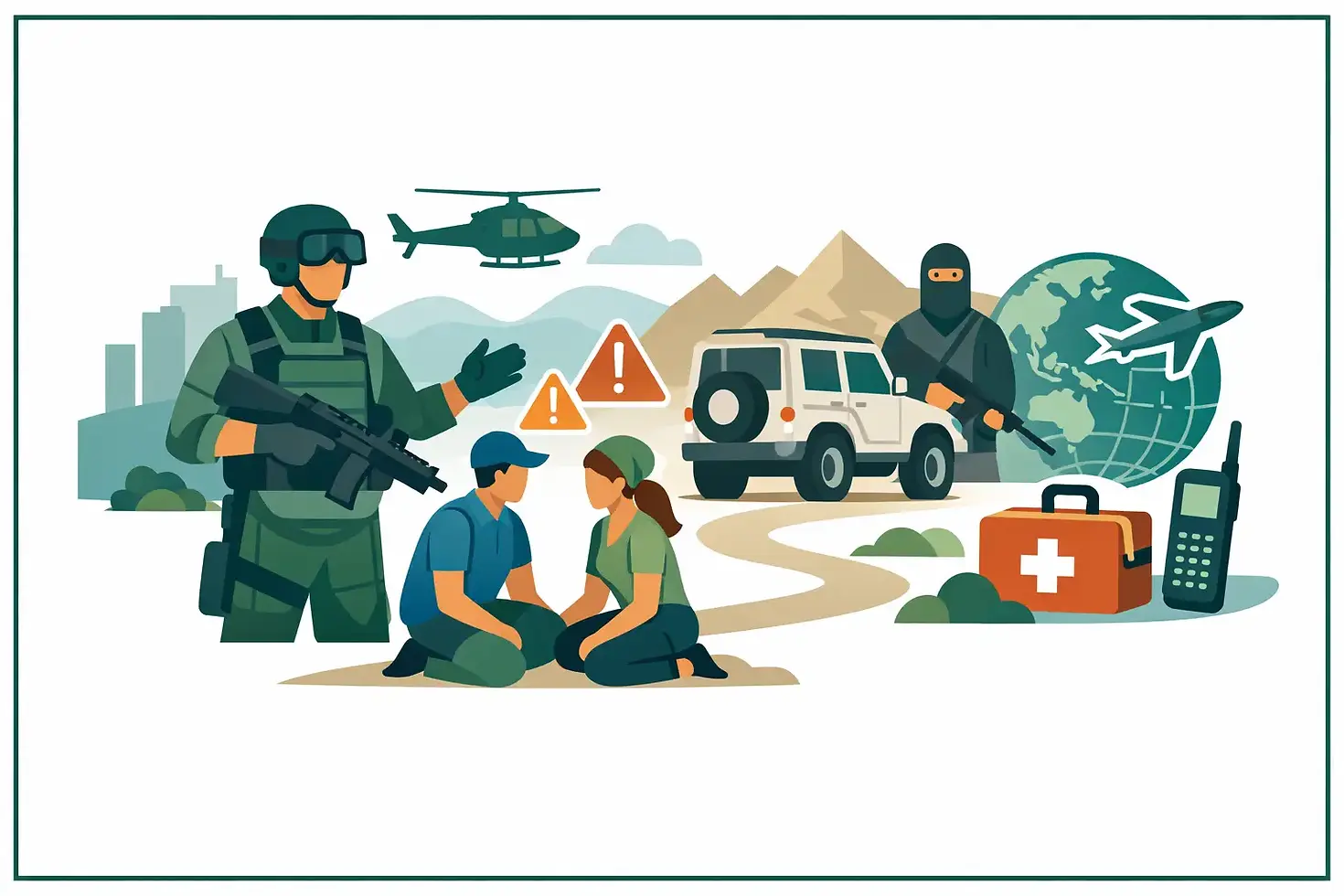
What a Hostile Environment Training Course Covers
- Coachaj Lifesaver
- Jun 27
- 6 min read

A delayed check-in. A route change at short notice. A routine site visit that suddenly no longer feels routine. These are the moments when a hostile environment training course stops being a procurement line and becomes part of an organisation's duty of care.
For security managers, NGO leaders, operations directors and compliance teams, the question is rarely whether risk exists. It is whether staff are prepared to recognise it early, respond under pressure and make sound decisions when support is limited. That is the real purpose of this type of training. It is not about theatrics. It is about readiness.
What is a hostile environment training course?
A hostile environment training course is structured preparation for personnel who may work, travel or deploy in unstable, remote or high-risk settings. That can include conflict-affected regions, civil unrest, politically sensitive locations, isolated project sites, disaster zones or areas with elevated criminal threat.
The strongest courses blend security awareness, medical response, situational judgement and incident management. They are designed to help participants function effectively when normal support systems are disrupted. In practice, that may mean managing an injured colleague before evacuation is possible, handling an aggressive checkpoint encounter, responding to a kidnapping threat, or making decisions during a vehicle incident far from immediate assistance.
The term itself can sometimes create the wrong impression. A good course does not turn civilians into security operators. It equips professionals to reduce exposure, think clearly and protect themselves and others while carrying out legitimate work.
Who needs hostile environment training?
The simple answer is any organisation sending people into environments where the operating picture can change quickly.
That often includes humanitarian agencies, journalists, maritime personnel, energy and infrastructure teams, government contractors, security-adjacent roles and companies with staff travelling to fragile or remote regions. It can also apply to senior executives, project managers and technical specialists who are not security professionals but still face elevated risk because of where they need to go and what they need to do there.
This is where many organisations misjudge the requirement. They assume hostile environment preparation is only necessary for front-line responders. In reality, the finance lead visiting a field office, the engineer inspecting a remote asset and the school or charity team deploying into a stressed region may all need some level of training. The content and depth should match the role, the threat profile and the likely duration of exposure.
What a hostile environment training course should cover
A credible course is practical, scenario-based and aligned with real operating conditions. Classroom theory has value, but knowledge alone is not enough when fatigue, uncertainty and time pressure are involved.
Risk awareness and pre-deployment planning
Preparation starts before travel. Participants should learn how to assess destination risk, review routes, understand local threat patterns, plan communications and consider accommodation, transport and medical support. This part of the course helps people think beyond itinerary logistics and focus on exposure points.
It should also address cultural awareness, legal considerations and behavioural discipline. In many environments, avoidable attention creates unnecessary risk. How staff present themselves, communicate and move can affect whether they blend in, escalate a situation or become a target.
Situational awareness under pressure
Most incidents are preceded by indicators. A good course trains people to spot them without becoming jumpy or distracted. That includes reading the environment, identifying anomalies, understanding crowd behaviour and recognising when a situation is deteriorating.
This matters because many decisions in hostile settings are made with partial information. Personnel need a disciplined process for judging whether to continue, pause, reroute or withdraw. The aim is not paranoia. It is controlled awareness.
Personal safety and security behaviour
This usually includes movement on foot, vehicle safety, checkpoint conduct, hotel and residence security, communications discipline and what to do if surveillance or targeting is suspected. Depending on the course level, participants may also cover response to robbery, detention, abduction risk and civil disturbance.
There is no single script for every incident, and any provider claiming otherwise is overselling certainty. Good training explains principles, rehearses options and builds decision-making confidence. Context always matters.
Trauma care in austere settings
Medical capability is a core part of any serious hostile environment programme. In many high-risk or remote locations, the first few minutes after injury are decisive, yet professional medical support may be delayed.
Participants should learn how to manage catastrophic bleeding, airway issues, trauma assessment and casualty stabilisation while arranging onward care. The standard required is not the same as a general first aid class delivered for low-risk workplaces. The training needs to reflect hostile and resource-limited conditions, where evacuation timelines, scene security and kit limitations all shape what is possible.
Incident response and team coordination
Individuals rarely operate alone. Courses should therefore address team communication, emergency actions, rally points, reporting lines and leadership under stress. When an incident occurs, confusion and duplication waste time. Clear roles and simple drills reduce that risk.
This is especially important for organisations with mixed teams, such as international staff, local staff, contractors and drivers. If procedures are not shared and practised, assumptions break down quickly.
What separates a credible course from a superficial one
Not all training with the word hostile in the title is equal. Some programmes lean too heavily on dramatic scenarios and too lightly on operational relevance. Others are so generic that participants leave with theory but no practical confidence.
A credible provider will start with the client's risk profile, traveller types and deployment patterns. A course for an aid agency entering post-disaster zones should not look identical to a programme built for executives visiting politically sensitive markets. There will be overlap, but the emphasis should differ.
Quality also shows in the delivery model. Realistic exercises, qualified instructors, current threat understanding and clear links to organisational policy all matter. Certification has value, but certification alone is not proof of suitability. The real test is whether the training improves behaviour, decision-making and resilience in the field.
How to choose the right hostile environment training course
The best buying decision is rarely the cheapest course or the most extreme-looking one. It is the programme that fits your people, your operating environment and your duty of care obligations.
Start with your exposure. Are staff travelling briefly, living in country for long periods or moving between multiple sites? Are the main concerns medical isolation, criminality, unrest, conflict spillover or transport risk? Different threats require different emphasis.
Then consider participant background. Novices often need stronger foundations in awareness, communications and basic trauma response. Experienced personnel may benefit more from scenario complexity, refresher drills and role-specific decision-making.
You should also look closely at delivery standards. Can the provider tailor scenarios? Do instructors understand corporate, humanitarian or government operating realities? Is the course appropriate for both policy compliance and practical field use? In Abu Dhabi and across the wider region, organisations increasingly expect training partners to combine accredited standards with local delivery capability and operational credibility. That expectation is reasonable.
Why organisations treat this as a duty of care issue
When staff are deployed into elevated-risk environments, training is not simply a development benefit. It is part of governance. Employers are expected to identify foreseeable risks, prepare personnel appropriately and show that reasonable preventive measures are in place.
That has legal, ethical and reputational dimensions. If an incident occurs, questions will be asked about planning, briefing, medical readiness, communications and decision authority. A hostile environment training course cannot remove risk altogether, but it can demonstrate that the organisation took preparation seriously and equipped people with practical tools rather than vague assurances.
There is also a human factor that procurement language tends to miss. People work better when they know their employer has thought through their safety properly. Confidence does not come from slogans. It comes from preparation that feels relevant, credible and usable.
The best outcome is often the incident that never happens
The strongest hostile environment training is not measured by how dramatic the exercise felt on the day. It is measured later, when a traveller changes route early, a field team spots escalation signs before they are trapped, or a casualty receives effective care before formal medical support arrives.
For organisations that operate in uncertain conditions, readiness is built before deployment, not during the crisis. A well-designed course gives people a framework for judgement, not just a certificate for the file. That is what makes training worth investing in - and what makes teams safer when conditions are least forgiving.


Comments