
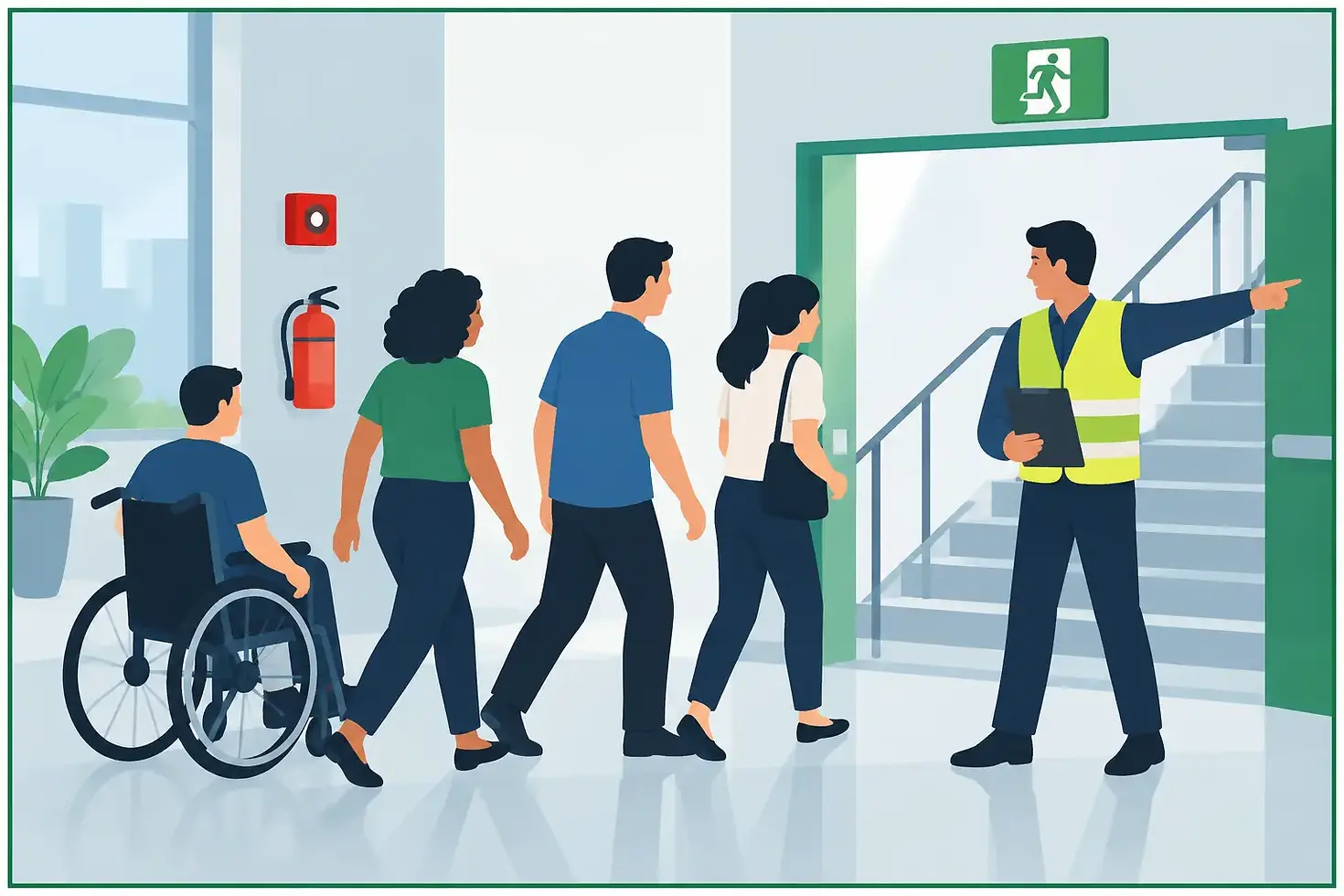
Essential Emergency Evacuation Roles Explained

When an alarm sounds, uncertainty spreads faster than smoke. People look for direction, lifts may be unavailable, visitors may not know the nearest exit, and a single unanswered question can delay the whole response. Clearly defined essential emergency evacuation roles turn a written plan into disciplined action.
For employers, schools, facilities teams and field-based organisations, evacuation readiness is not achieved by displaying a floor plan near a stairwell. It depends on people who understand their authority, their limits and the sequence of actions expected of them. The objective is simple: move everyone to safety without creating additional risk, account for them accurately, and give emergency responders reliable information.
Why essential emergency evacuation roles matter
An evacuation plan must work under pressure, with incomplete information and changing conditions. The person who discovers a fire, gas leak, security threat or structural concern may not be a safety specialist. The people leaving the building may include new starters, contractors, visitors, children or colleagues requiring assistance.
Assigning roles in advance avoids duplicated effort and dangerous assumptions. It establishes who raises the alarm, who coordinates the response, who checks assigned areas, who supports those with agreed evacuation arrangements, and who confirms attendance at the assembly point.
The right structure depends on the premises and the risk profile. A small office may need a trained evacuation coordinator and several wardens. A school, warehouse, healthcare setting, accommodation site or remote operational base may require a larger team, shift coverage, security support, first aid provision and clear links to external emergency services. Titles can vary, but responsibilities must not.
Core emergency evacuation roles and responsibilities
The incident controller
The incident controller, sometimes called the evacuation coordinator, leads the organisation's immediate response until emergency services take command. This person does not need to investigate the incident or act as a firefighter. Their role is to activate the emergency plan, direct wardens, maintain communication and make sure critical information reaches responders.
At the assembly point, the incident controller should receive reports from wardens and the person responsible for roll call. They must be able to state whether the building has been cleared as far as safely possible, whether anyone is unaccounted for, and the last known location of any missing person. They should never send untrained staff back inside to search.
A deputy is essential. Emergencies do not wait for the designated lead to return from a meeting, holiday or off-site assignment. For multi-shift operations, each shift needs named coverage.
Fire wardens or evacuation wardens
Wardens guide people away from danger through the safest available routes. They should know their allocated zone, primary and alternative exits, assembly arrangements, alarm call points and locations of firefighting equipment. Their task is not to force a search of an unsafe area. If smoke, heat, violence, structural damage or another immediate threat is present, they withdraw and report it.
A warden's responsibilities normally include encouraging people to leave promptly, checking accessible spaces where it is safe to do so, closing doors behind them where appropriate, and reporting their zone status. They should also remain alert to common delays: people returning for personal belongings, visitors waiting for a host, or staff assuming an alarm is a drill.
Wardens need enough authority to be heard, but calm communication matters more than volume. Clear instructions such as "Use the east stairwell", "Do not use the lift" and "Proceed to Assembly Point B" reduce hesitation.
The alarm and communications lead
In smaller sites, the incident controller may handle communication. In larger or more complex settings, it is sensible to assign this responsibility separately. The communications lead ensures alarms are raised, emergency calls are made where required, and accurate information is passed to staff, visitors and responders.
This role should have access to current contact details, site plans, keyholder information and a method for communicating if normal systems fail. For example, a large facility may use radios, while a school may rely on designated staff with loudhailers or agreed messaging procedures. Technology is useful, but the plan must still function during a power or network outage.
Communications must be factual. Do not speculate about the cause of an incident, tell people that an area is safe without confirmation, or announce re-entry before it has been authorised by the responsible authority.
The assembly point and roll-call lead
Evacuation is not complete when people reach the pavement or car park. The assembly point lead establishes order at a safe designated location and confirms who is present, missing or known to be off site.
Accurate records are central to this role. Staff lists, visitor registers, contractor sign-in records and pupil registers, where relevant, must be current and accessible. A digital system can help, but there should be a workable manual alternative. During an emergency, a perfect database that cannot be accessed has little value.
The roll-call lead should report only confirmed information. If someone is missing, provide their name, work area or last known location, and any relevant mobility, medical or access information. This gives emergency responders a clearer operational picture without sending colleagues into danger.
First aiders and welfare support
First aiders provide immediate care within their training and available equipment. They may treat minor injuries at the assembly point, identify people who need urgent medical attention, and support handover to ambulance crews. They should not compromise their own safety or attempt treatment in an unsafe area.
Welfare support is equally significant. Evacuation can be distressing for children, visitors, people with anxiety, pregnant employees and individuals with sensory or mobility needs. A calm, informed member of staff can prevent panic and help people remain at the assembly point until the situation is resolved.
Support for people needing assistance
Evacuation plans must account for people who may require assistance before an incident occurs. Personal Emergency Evacuation Plans, often known as PEEPs, set out practical arrangements for individuals with mobility, hearing, visual, cognitive or temporary needs.
Support arrangements should be agreed respectfully and reviewed regularly. They may involve trained buddies, evacuation chairs, refuge points, visual alarm devices or adapted communication. The correct approach depends on the building, the individual and the type of emergency. A plan that assumes one solution fits everyone can leave people at greater risk.
Build a structure that works on every shift
Role names on an organisation chart are not enough. Every responsibility needs a named primary person, a trained deputy and a method for handover. This is particularly important in sites operating evenings, weekends or rotating shifts, and in workplaces with frequent contractors or visitors.
Avoid assigning too many duties to one person. A facilities manager may be highly capable, but they cannot simultaneously coordinate an evacuation, conduct roll call, call emergency services, manage security access and administer first aid. Separate responsibilities where the size and risk of the site demand it.
Competence matters as much as appointment. Role holders should understand the site-specific plan, take part in realistic drills and know when to stop. They should be familiar with escape routes and assembly points, but also with the boundaries of their role. No warden should be expected to enter smoke, confront a violent person or conduct a rescue beyond their training and equipment.
Test the plan, then improve it
A drill is not a performance for an audit. It is an opportunity to find delays before they matter. Test different conditions: a blocked exit, a missing visitor record, a warden on leave, reduced lighting, a shift change or an assembly point affected by weather or traffic.
After each exercise, hold a short debrief while details are fresh. Record what worked, where instructions were unclear, how long the process took and whether anyone was not accounted for promptly. Update the plan, brief the relevant people and test the changes again.
Training should include both the practical actions people must take and the reasons behind them. When staff understand why they must not use lifts, re-enter for belongings or leave the assembly area early, compliance becomes more reliable. Accredited first aid and emergency response training can also strengthen the confidence of nominated teams, particularly where workplaces face higher operational risk.
Lifesaver Abu Dhabi supports organisations with practical, tailored safety training designed to strengthen readiness from the first alarm through to coordinated recovery.
The most dependable evacuation teams are not those with the longest procedures. They are the teams who know who is leading, where they are going, how people will be accounted for, and when to hand control to emergency responders. Put those decisions in place now, practise them with purpose, and your people will have clearer direction when it matters most.


Comments