
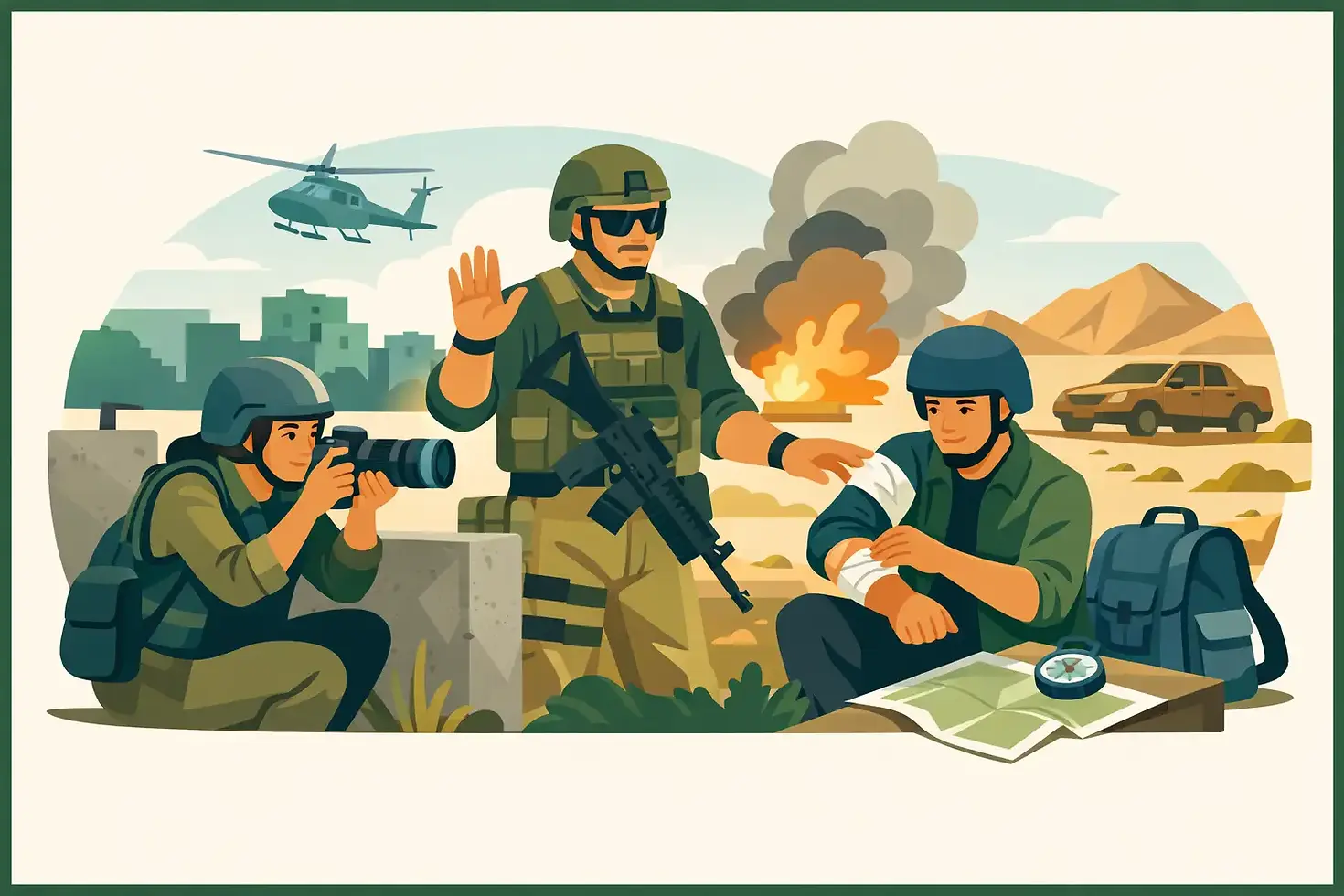
Hostile Environment Training for Journalists
- Coachaj Lifesaver
- May 28
- 6 min read

A press card does not stop a checkpoint, calm a crowd or treat a catastrophic bleed. When an assignment moves from routine reporting to civil unrest, conflict exposure or remote fieldwork, hostile environment training for journalists becomes part of basic professional readiness, not an optional extra.
For editors, bureau leads, NGOs and independent reporters, the issue is not simply whether a journalist can get into a difficult location. It is whether they can work there with sound judgement, recognise deterioration early, communicate clearly under pressure and return safely. Good training does not promise safety in every scenario. It improves decision-making when the environment is unstable and the margin for error is small.
What hostile environment training for journalists covers
At its best, hostile environment training for journalists is built around the realities of editorial work. Reporters and camera crews move differently from security teams. They may need to approach crowds, interview distressed sources, travel with local fixers, operate with limited support and make rapid choices without a formal command structure.
That means the course content has to go beyond generic risk advice. Journalists need practical methods for route planning, movement in urban and rural risk areas, checkpoint conduct, vehicle awareness, situational observation and personal security discipline. They also need to understand how quickly a manageable assignment can turn into a medical emergency or extraction problem.
A serious programme will usually include trauma first aid, casualty prioritisation, haemorrhage control and immediate actions after blast, gunfire or vehicle incidents. It will also address kidnap avoidance, hostile crowd dynamics, digital and communications discipline, and the legal and ethical pressures that affect reporting decisions in the field.
Just as important, the training should reflect the editorial context. A freelance photographer on short deployment, a documentary team entering a fragile region and a correspondent covering protests in a capital city may all need hostile environment training, but not in the same way or at the same level.
Why journalists need more than a generic safety briefing
Many organisations still rely on pre-departure notes, insurance documents and a short briefing call. Those measures matter, but they are not a substitute for practical training. Reading about an arterial bleed is not the same as managing one under time pressure. Knowing that checkpoints are risky is not the same as rehearsing how to present yourself, what to say, when to stop talking and how to read behavioural warning signs.
Journalism creates particular exposure because the job often requires proximity. Reporters work near demonstrations, damaged infrastructure, volatile public gatherings and traumatised communities. They may be seen as neutral observers, but they may also be viewed as suspicious, provocative or aligned with one side. That perception can change by district, by hour and by who controls the ground.
Training helps bridge the gap between theory and action. It conditions participants to slow the situation down mentally, assess priorities and follow a process when stress starts to distort judgement. That matters for new journalists, but it matters just as much for experienced teams. Familiarity can create its own risk if confidence begins to replace discipline.
The most valuable outcomes are judgement and composure
People often assume hostile environment training is mainly about dramatic scenarios. In practice, the strongest courses are often less theatrical and more disciplined. The aim is not to turn journalists into security operators. It is to improve survivability, fieldcraft and decision quality.
That starts with threat recognition. Participants learn how to identify pattern changes, environmental cues and behavioural indicators that suggest a situation is deteriorating. They practise making early calls rather than late ones. Leaving ten minutes sooner, choosing not to force an interview, changing a route or pausing movement until information is verified can be the difference between a near miss and a serious incident.
Medical confidence is another major outcome. In high-risk reporting, emergency services may be delayed, absent or overwhelmed. Journalists may need to care for themselves, a colleague or a local partner during the critical first minutes. Competence in trauma response does more than improve casualty care. It reduces panic, gives structure to the response and supports better communication with extraction or medical providers.
Then there is composure. Under stress, people rush, narrow their focus and miss obvious indicators. Repetition, drills and scenario work help create a controlled response. No course can remove fear, nor should it. The goal is to keep fear from dictating decisions.
What a credible course should look like
Not all training labelled HEAT is equal. Some programmes are highly relevant to media teams. Others are generic packages with little understanding of how journalists actually operate.
A credible course should be scenario-based and instructor-led by people with genuine field and training experience. It should include practical drills, realistic casualty management, movement exercises and communication under pressure. Classroom input has a role, but a course made up mostly of slides will not prepare people for field stress.
Relevance matters just as much as intensity. The best providers tailor delivery to assignment profile, destination risk, team composition and organisational duty of care. A newsroom sending staff into civil unrest in a major city needs different preparation from a humanitarian media unit travelling into austere terrain. One-size-fits-all training may tick a procurement box, but it can leave capability gaps.
Assessment should also be part of the picture. Participants do not need to be tested like military candidates, but they should leave with clear evidence of competence in core tasks. Can they use a trauma kit properly? Can they produce a basic movement plan? Can they communicate an incident clearly? Can they make a sound decision when information is incomplete?
How organisations should choose hostile environment training for journalists
Procurement teams and editors should start with the assignment, not the course brochure. Where are teams going, what are they expected to do and what support will they have if something goes wrong? From there, it becomes easier to judge the right training depth.
For some organisations, the need is recurrent capability. Staff and freelancers require scheduled training, refreshers and standardised field protocols. For others, the need is assignment-specific preparation for a particular region or event cycle. Both are valid, but they require different delivery models.
It is also worth checking whether the provider can adapt to mixed groups. Media teams often include producers, camera operators, drivers, fixers and support staff. Their risk profile is shared, even if their roles differ. Training is more effective when the team learns together and understands each other’s responsibilities in a crisis.
In Abu Dhabi and across the wider region, organisations often look for a provider that combines accredited instruction with practical execution and local delivery capacity. That matters when training must align with broader duty-of-care planning rather than sit as a standalone course.
Common mistakes that weaken field readiness
The first mistake is treating training as a compliance exercise. If the only goal is to say a journalist has attended a course, the organisation will probably choose the cheapest, shortest and least demanding option. That may satisfy paperwork, but it does not build capability.
The second mistake is focusing only on extreme conflict. Hostile environments are not limited to war zones. Election unrest, communal tension, post-disaster instability, border movements and remote assignments with poor medical access can all present serious risk. Journalists do not need to be embedded near active fighting to require proper preparation.
The third mistake is failing to refresh. Skills decay quickly, especially medical and procedural skills that are not used often. A strong initial course should be followed by refresher training, equipment checks and internal drills before deployment.
Finally, organisations sometimes train the journalist but ignore the system around them. Good field safety depends on clear escalation routes, reliable communications, equipment standards, insurance alignment and managerial support for stop-work decisions. Training works best when it sits inside a wider operational framework.
Training should support reporting, not obstruct it
Some journalists worry that formal safety training will make reporting more cautious, less agile or too security-led. Poorly designed programmes can have that effect. Good training does the opposite. It gives reporters the confidence to work methodically, ask better questions about risk and keep reporting when others are forced to withdraw through preventable mistakes.
That balance is essential. Journalism depends on access, curiosity and independence. Training should protect those qualities, not suppress them. The point is not to make every assignment feel dangerous. The point is to recognise when it is, and to respond with discipline.
For organisations that send people into uncertainty, hostile environment training is one of the clearest expressions of duty of care. It tells staff and freelancers that safety is being treated as an operational responsibility, not a personal gamble. Providers such as Lifesaver Abu Dhabi understand that standard, because effective training is not just about instruction. It is about readiness that holds up when conditions deteriorate.
When the story pulls a team towards instability, the right preparation does not make the risk disappear. It helps people think clearly, act early and come home with both the story and their colleagues intact.


Comments